“If you’re doing the caring at your own home, for your own children and for yourself and possibly have a busy career as well – you're already doing a lot. Don’t add more to your load. Add quality to your load and let someone else do it.”—Elizabeth Albury, GM of Service Delivery, Australian Unity
Contents
Asking someone else to step into the critical, intimate role of caring for your mum or dad can feel daunting. Especially if you’ve been solely carrying the load for a while. But often, sharing that load is the best thing you can do—not just for your parent’s wellbeing, but for you and your relationship with them.
One of biggest barriers to getting started is the complexity of the care sector, but helping your parent recognise they might need a little extra support to continue living well is also a challenge.
Having the right people in your corner—people your parent trusts—makes all the difference.
That’s why this is an important time for you to be involved and ensure your parent is set up correctly with the right supports in place. So, what milestones should you be involved in? Ideally, as many as possible.
These may include encouraging your parents to receive help, assisting with the My Aged Care application, attending assessments and being present when their care plan is written. If you get these right and work collaboratively with your parents from the beginning, everything will flow much more smoothly.
“Your mum and dad will talk to the My Aged Care assessment team about their best day, whereas they need to talk about their worst day. The sandwich generation must have a big voice at those critical moments. Without help, my parents wouldn't have answered the assessment questions accurately and would have been at risk of being incorrectly assessed,” says Elizabeth Albury, GM of Service Delivery at Australian Unity.
At Australian Unity, we've helped thousands of families find the right care. Here’s how you can find care that works for your parent and also you, according to the experts.
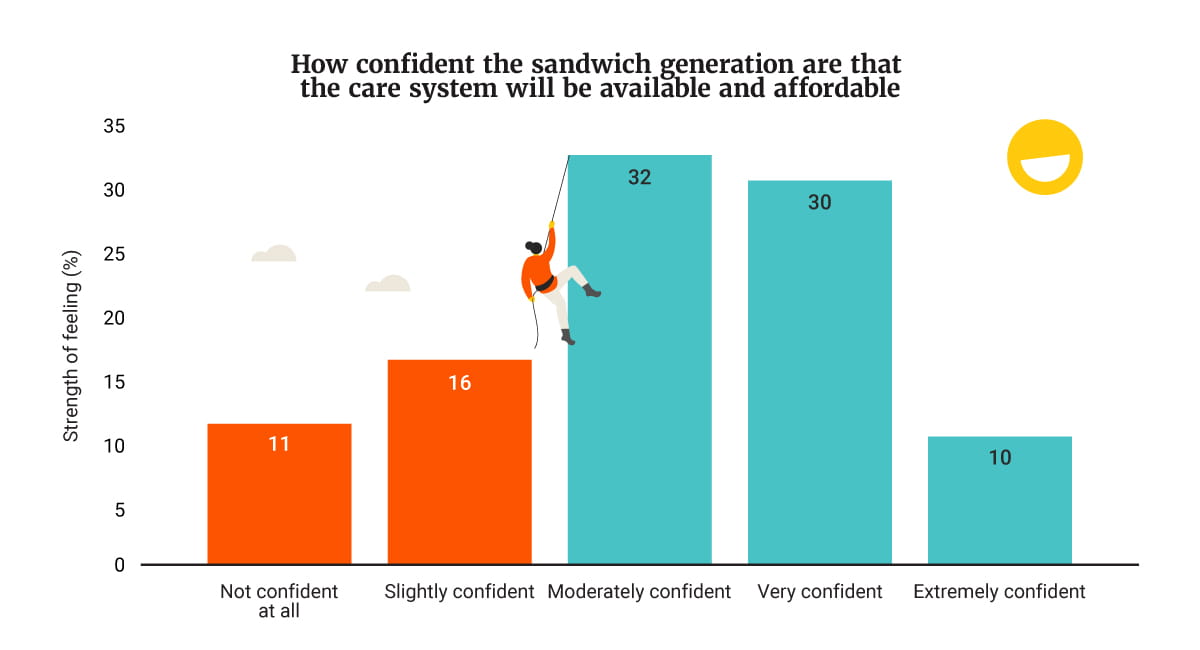
Data sourced from an Australian Unity survey using Kantar Profiles raw data to understand views of the sandwich generation.
The care options available for your ageing parents
Care isn’t just for when things get hard. Even if your parents are happily embedded in the family home, it’s never too early to start thinking about care and living arrangements that will support their wellbeing as they age. Of course, there’s a lot to consider—including some options you and they may not have heard about.
We list what’s available so you can have an open conversation with your parents and help them make the right decision, with their head and their heart.
Home health and care services
What are the benefits?
Home health and care services enable older Australians to continue living safely and comfortably in their own home and community for longer.
It includes clinical support (like in-home nursing, physio and podiatry), independence support (personal care, respite and social support), everyday living help (cleaning, laundry, meals and home maintenance) and short-term care pathways such as restorative and end-of-life care.
Elizabeth says there are often flow-on benefits too.
If an older Australian accepts a personal care service to help them shower, there is the initial benefit of increased hygiene.
There’s also the benefit of mitigating unsafe practices which might lead to a fall. This means they are less likely to slip, injure themselves and potentially end up in hospital.
And then there’s the social benefit of a human being coming into the home every week, which helps address the loneliness and isolation that older Australians can experience.
Find advice on how to talk to parents about in-home care here.
Who is it right for?
“Home care is for anyone over the age of 65 who has early signs of needing support in the home,” says Elizabeth.
By getting started early, older Australians can prevent injuries and treat conditions before they get more serious, all while living at home.
Meet Maggie, who uses our home health and care services to maximise her free time.

Retirement communities
What are the benefits?
Retirement communities allow older Australians to maintain their independence and build real community connectedness, while providing easy access to supports and facilities.
One of the biggest retirement community benefits is the social connection. There is often a community centre or cafe with weekly activities, music groups, trivia and other activities.
Residents in retirement communities can be some of the most social people you’ll encounter, says Ruth Zammit, General Manager of Retirement Communities at Australian Unity.
“The increased access to GPs, allied health and home care also usually means you can delay the need to move into an aged care facility,” says Ruth. “We’ll often have a pool, a gym and different exercise classes such as chair yoga or a physiologist session to help people maintain their health.”
The communities are purpose-built with added security and safety features such as emergency call systems which older Australians may not have in their own home.
Who is it right for?
“Strictly, it’s for over 55s but really it’s for people who are looking to keep their independence, be social and have the ability to be supported,” says Ruth.
A retirement community might be the way to go if your parents are seeking a lifestyle where they would like to prioritise community—especially if they feel socially isolated or rely on you for companionship—and reduce the amount of time they spend on household upkeep.
Meet Robyn, who found unexpected happiness in a vibrant retirement community.
Residential aged care
What are the benefits?
Residential aged care provides room-based accommodation and professional staff who are available 24/7, carrying out tasks for residents including cooking, cleaning, providing medical support and organising social events.
“There are geriatricians, GPs, registered nurses and allied health specialists all effectively working onsite, so you've got easy access for whatever your complex care needs might be,” says Brett Lafranchi, General Manager of Aged Care at Australian Unity. “It gives families reassurance and peace of mind that if they can't go and visit mum today, she hasn’t missed her medication.”
Another benefit is the sense of community. Residents can dine and socialise with others and take part in a range of activities such as excursions, arts and craft, and music and entertainment.
Who is it right for?
“If you can no longer live full time, permanently and independently at home, residential aged care may be the perfect offering,” says Brett. “Your parent might be in decline, their health care needs may have increased, they may have had a medical episode or hospital admission, or they may have a cognitive impairment.”
Meet Anna, who is grateful to have found a home that is happy and safe.

Respite care
What are the benefits?
Respite care allows carers to support their own wellbeing by taking a break from their caring responsibilities.
“Carers might have a very urgent practical need for a break, but we also encourage carers to take a break so they can sustain caring and parenting and working and juggling responsibilities,” says Annabel Reid, CEO at Carers Australia.
There are multiple types of respite care for carers.
Having people within your network such as friends or family care for your mum or dad is an informal type of respite care. Professional in-home respite care is a formal option which is available via My Aged Care or NDIS. The benefit of these options is that your parent can remain in the familiar setting of their own home.
Longer term respite is available in residential aged care communities, however they may have a two-to-four-week minimum stay depending on the community.
“Taking respite doesn't mean the person you care for is a burden. It's a necessity to ensure that your own health is being sustained,” says Annabel.
Who is it right for?
“All carers should be looking at forms of respite,” says Annabel.
However, there can be access challenges for people who live regionally or are caring for someone with complex care needs.
But it’s vital that you’re able to take a break. To learn more about the different types of respite and how you can access them, visit the Carer Gateway.
So, who pays for what?
When it comes to deciding on the right type of care, cost is undeniably a big factor.
That’s why getting assessed by My Aged Care is often the best starting point. This way you’ll know exactly what care your parent is eligible for and what amount of funding they’ll receive. This will play a big role in the decision-making process.
It's also vital to know all related fees before signing any agreements. Seeking independent financial advice can save you financial stress down the road.
Here is a short summary of the funding and fees associated with the different care options.

Home health and care services
Getting familiar with how in-home care for elderly parents works—including the funding—is worth the time. It means you’re ready before circumstances make the decision for you.
“There are several different funding programs. There’s an entry level program, Commonwealth Home Support, which is a good option to get started. Then there is the Support at Home program which covers the more complex needs of ageing across many elements of staying safe and active in your own home,” says Elizabeth.
Care can also be funded privately, which may be worth considering if you're looking for more flexibility or faster access to services.
How much you need to contribute will depend on your parent's financial situation—whether they're a pensioner, part-pensioner or self-funded retiree—and a financial assessment will help determine the right level of contribution.
“The tricky part about home care is there's no one size fits all. You've got to do it case by case by case, and financial considerations come into that.”
— Elizabeth Albury,
GM of Service Delivery,
Australian Unity
Elizabeth’s final advice? Don’t let the opinions of others or assumptions influence you. Start the process early and let the system guide you to the appropriate services.
Retirement communities
“Usually people have three types of payments—a payment when you move in, payments while you live there and a payment at the end,” says Ruth. “The initial fee is like a purchase price. The payments throughout are weekly or monthly fees that support the ongoing functioning of the retirement community. Then when the resident leaves there will be a deferred fee as part of the arrangement.”
The amounts will differ depending on the retirement community. Generally, there is no government funding for living in a retirement community.
“In general, retirement communities are seen as one of the more affordable options for accommodation. There’s usually a retirement village that will suit your circumstance and budget,” says Ruth.
Residential aged care
Your parent will undergo an asset and income test to determine whether they will need to make contributions if they can reasonably afford to do so.
Generally speaking, every resident is required to pay a daily care fee which sits at 85% of the single person rate of the basic age pension. There is also a price attached to each bed, and you can pay this fee in one of two ways: a lump sum or a daily accommodation payment. You can also do a combination of both options. If your parent qualifies for low means status in the asset and income test, the government may contribute towards their accommodation costs.
“Residential aged care is mostly government funded, so you don't have to reach into your pocket and pay all of the fees.”
— Brett Lafranchi,
General Manager of Aged Care,
Australian Unity
“If someone doesn’t own their own home or have money in the bank, they still have the right to access residential aged care,” says Brett.
When choosing aged care options, keep in mind that different aged care communities have different costs.
Respite care
Each different type of respite care is funded differently.
For short-term care in the home, if the person you care for is eligible for My Aged Care or NDIS, the government will contribute to the fees. The amount they contribute will depend on the situation and level of care required.
For longer-term residential respite care, which occurs in an aged care facility, the government also offers some funding but again, this may not cover all costs involved.
“We describe it as a patchwork quilt of options; they’re all quite different,” says Annabel.
Learn more about financial considerations and helping your parents plan their post-retirement finances.
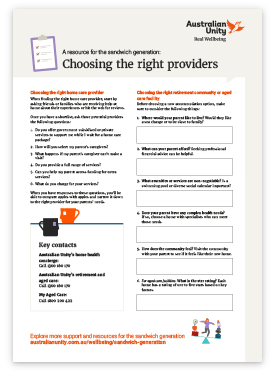
Choosing the right providers
Whether your parent is exploring home care or considering a retirement community, the options can feel overwhelming. This resource helps you and them ask the right questions so your parent can feel confident in their choices.