“The sandwich generation refers to somebody who is both parenting and caring for their ageing parent, which means they’re sandwiched in between the two different types of responsibilities.”—Annabel Reid, CEO, Carers Australia
Contents
Does this sound familiar? Caring for your kids. Supporting ageing parents. Feeling completely stretched thin. Welcome to the sandwich generation. Don’t worry, you're not alone.
You probably don't think of yourself as a carer, but if you're supporting an ageing parent or helping someone manage their health and wellbeing, that's exactly what you are.
According to the 2025 Carer Wellbeing Survey, only 38.9% of carers report healthy wellbeing, which is half that reported by the general Australian population. A third of all carers also experience high psychological distress.
And for the sandwich generation, the numbers are even more drastic.
The data tells a compelling story, but behind the statistics are real people navigating complex responsibilities. That’s why we’re shining a light on the sandwich generation.
In this chapter, we explore common challenges and pain points that the sandwich generation experience. You might find yourself nodding along or even breathing a sigh of relief that you’re not the only one. And we won’t leave you in the lurch. You’ll learn how to take control of your journey and face these experiences head on—not just to protect your own wellbeing, but also the wellbeing of your loved ones.
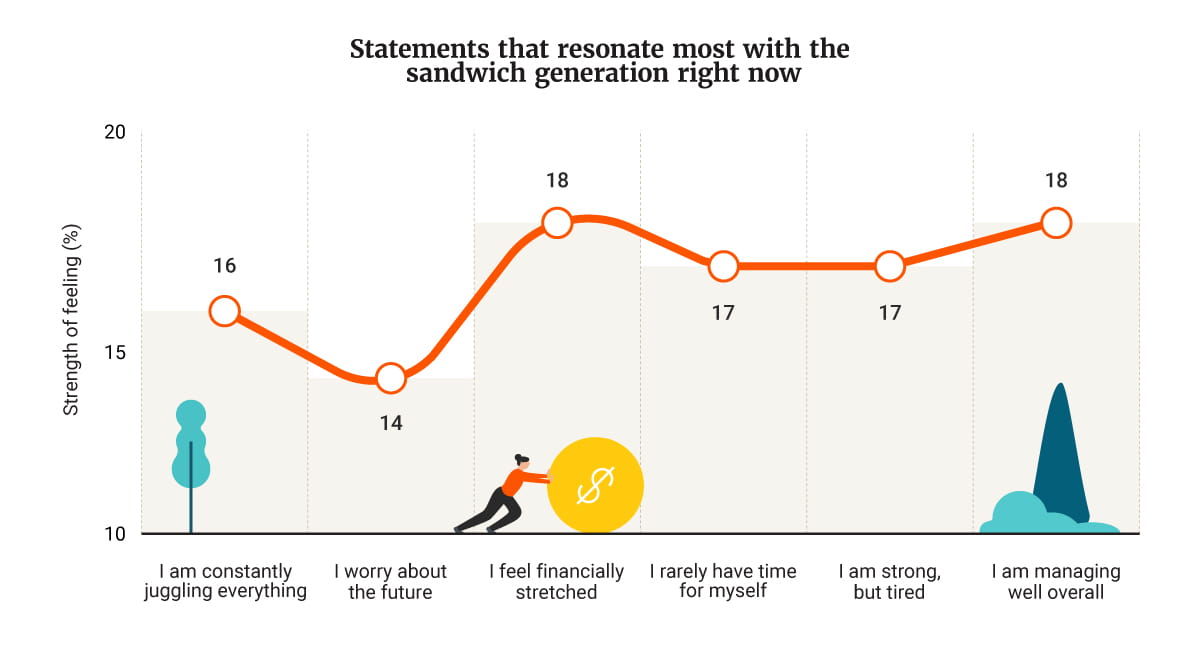
Data sourced from an Australian Unity survey using Kantar Profiles raw data to understand views of the sandwich generation.
Navigating the emotional load
Pressure. It's real. And you know first-hand that caring for children while supporting your parents is like burning the candle at both ends.
“Caring for children is a really large time commitment. But when you’ve also got ageing parents, especially if they have difficult behaviors like dementia, things get very challenging to manage,” says Annabel Reid, CEO of Carers Australia.
She adds: “If you're trying to pile those responsibilities on top of full-time work and managing a family and having friends and all those other things—the time pressures mount up, and it often means you don't have time for yourself.”
Stress, burnout, identity loss, relationship strain, grief and social isolation are common experiences—enough to test anyone’s resilience.
So, what challenges do the sandwich generation face?
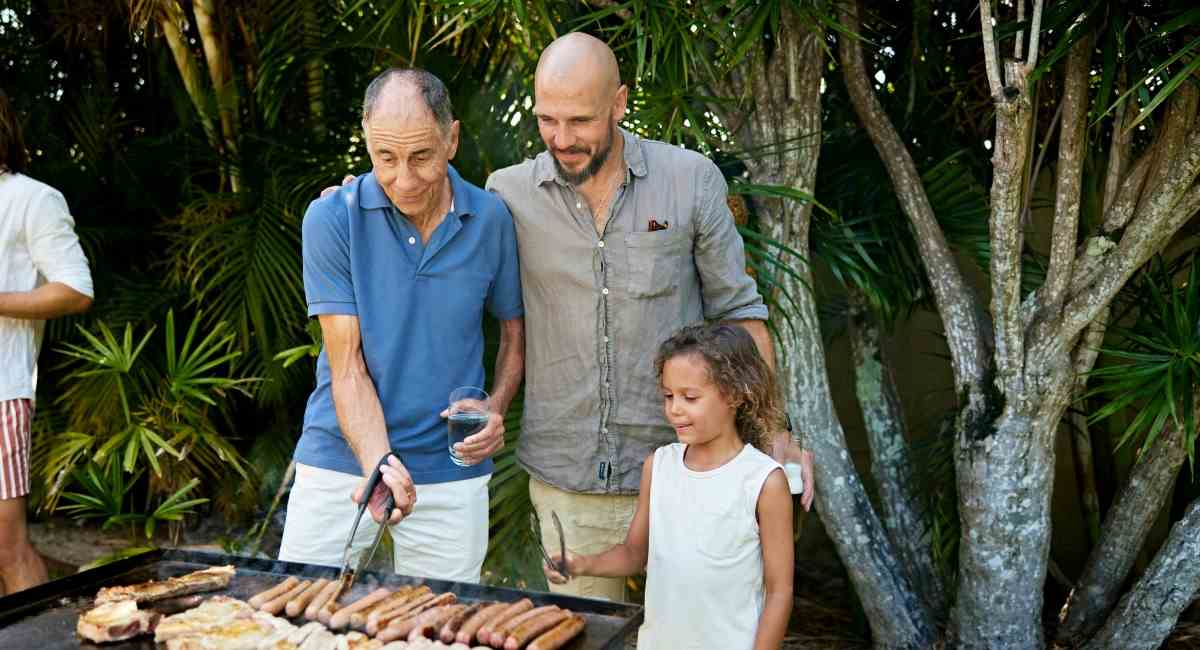
Challenges of the sandwich generation
“Sandwich generation carers often have no time, but they also have a high cognitive load leading to emotional distress. You might be worried about whether you've done enough or done the right thing or you've got really difficult decisions to make,” says Annabel.
Inouk Mackay, Mental Health Coach at Australian Unity, agrees that two of the biggest challenges for the sandwich generation are emotional overload and time constraints.
“You might need to take a parent to a medical appointment and in doing that you might miss your child’s concert or basketball match. There’s that constant feeling of being stretched thin,” she says.
You may also face challenges with your relationships, your finances and your job to name a few.
“If you’re putting in a lot of time to care for both parents and kids, it can put a strain on your partnership and with your friends. There could also be conflict with siblings over the share of responsibilities,” says Inouk. “Another significant factor can be financial challenges. If you’ve got multiple children and you’re supporting the financial needs of your parents, that can really add to the strain and burden.”
You might even need to reduce your work hours to fit it all in. In fact, according to the 2025 Carer Wellbeing Survey, 72.5% of carers reported a reduction in income due to caring responsibilities.
Combine all of these challenges, and there’s a good chance you’re feeling isolated, like you’re carrying a heavy load and as though you’re close to reaching your emotional capacity.
But with the right support, it can become more manageable.
How to combat those sandwich generation challenges
Annabel’s biggest piece of advice is to try to create space to care for yourself.
“Many carers feel a sense of guilt about doing this, or it just seems practically impossible because their schedule is so crazy, but it’s that old analogy of putting on your own oxygen mask before others,” she says. “If you care for yourself, then you’re better able to provide others with the support and care they deserve.”
To do this, you need to ask for help.
“Ask for help early, while you’re still coping. Carers tend to reach out when they’re in crisis and in a desperate situation. Don't feel guilty about getting help—it's a necessity,” says Annabel.
Owning your journey
While the challenges are very real, taking control and owning your journey is empowering.
Many carers find fulfilment in being there for someone they love. There's purpose, joy and meaning which contribute to a sense of Real Wellbeing.
Things might be tough, but what are the rewarding parts? Feeling like you’re everything to everyone can be exhausting, but how are you having a positive impact on the ones you love?
These are powerful reminders that help you through the challenging times.
“It can be really inspiring to support another person, especially when it’s someone you love. This might bring you closer to that family member and it can be a wonderful thing to build that close, powerful relationship,” says Annabel Reid, CEO of Carers Australia.
There are other things you can do to own your journey such as communicating openly with others and letting go of perfection.
And yes, it is okay to admit when things are not okay. In fact, it could be the first step to getting support.

Soaking up that sense of purpose
The Australian Unity Wellbeing Index—a 25-year study undertaken in partnership with Deakin University—has repeatedly found that a sense of purpose is key to personal wellbeing.
The sense of purpose you get from caring comes from loyalty, love and responsibility all rolled into one, says Inouk Mackay, Mental Health Coach at Australian Unity.
“It’s a time when you’re needed more than ever, and hopefully one day you can look back and know that you were there for the people that needed you. You showed up when it mattered, and you did your very best. You might even become a role model for your children or others close to you in that situation,” she says.
This is a time for huge emotional growth and maturity.
“When you’re going through things that you’ve never been through and possibly never thought you’d be able to manage, it can give you a huge sense of satisfaction,” says Inouk.
Be proud of yourself. You’re navigating a challenging and complex landscape, all to help the people you love.
Using open communication to own your journey
This is not a time to be shy or put yourself last. It’s vital to communicate openly and be clear about what you can and can’t take on.
“Just because you’ve been doing it all perfectly for the past few months, that doesn’t mean it’s automatically your role to do everything into the future.”
— Inouk Mackay,
Mental Health Coach,
Australian Unity
It can be hard to ask for help. Expressing your opinions and feelings in an assertive way, all while remaining respectful and open minded, is a challenge for many.
Not sure how to start? Try saying, “I have to be at my child’s soccer game, so someone else will need to take mum to a medical appointment on that day.”
You may need to reduce your workload and responsibilities to avoid burnout. So, consider how you can approach these tough conversations and communicate your needs with others.
“Think about what would be most helpful for you to offload. What could you share? What boundaries can you set to ensure you get a bit more support? And then approach those conversations with purpose,” says Inouk.
Letting go of perfection
If Inouk has one piece of advice for you, it’s to stop reaching for perfection. Consider this an act of self-care for the sandwich generation.
“Sometimes you need to let go of your standards and stop wanting everything to go perfectly. You definitely do not need to be perfect,” she says. “Be open and honest about the fact that you’re probably not enjoying yourself, that this is really hard, and it’s really complex and emotional at times."
It’s about showing up and giving it your best in whatever capacity you have. And regardless of what you may think, you’re doing an amazing job!