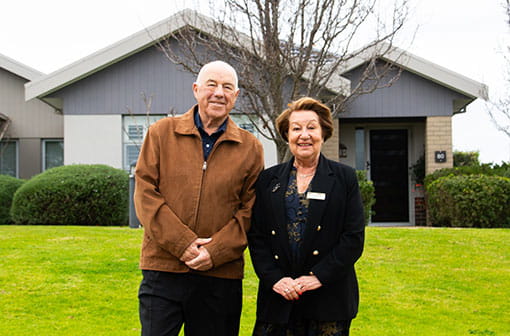
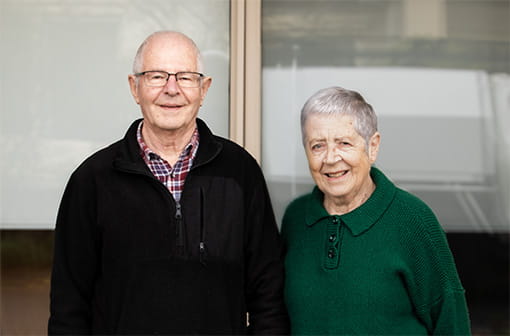
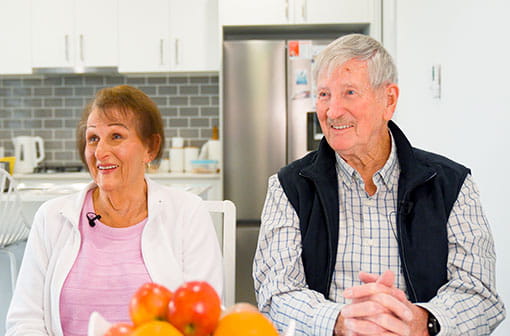
“He’s my soulmate and we have a lot of fun. It’s been a really good 61 years.”—Lynn Jeston, Australian Unity home care customer
Key points
- Lynn and George Jeston met at a bakehouse in Newcastle over 60 years ago and have been inseparable ever since.
- When falls and a serious operation made independent living harder, home care gave them the support to stay together in a home of their own.
- Their eldest daughter Michelle and care worker Tina both play a part in keeping Lynn and George active and connected.
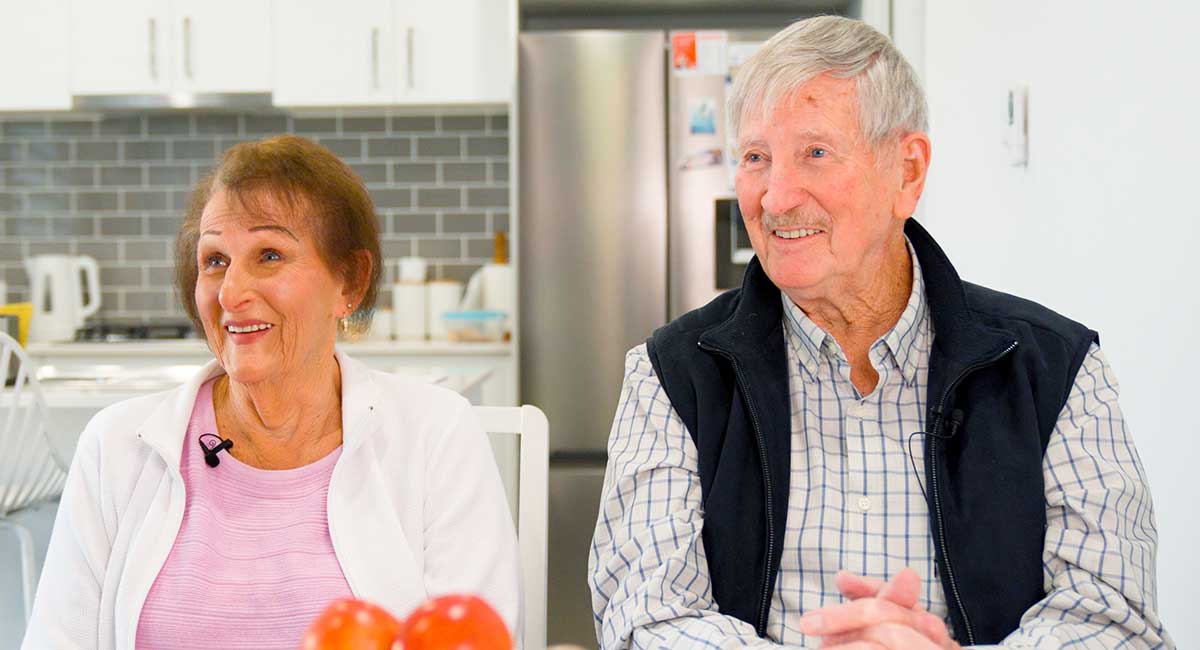
After six decades together, ask Lynn what she loves about George and she doesn’t hesitate: “He’s just my soulmate, we have a lot of fun and it’s been a really good 61 years.”
These days, Australian Unity home care looks after the things Lynn and George can no longer manage themselves—the cleaning, the lawn, the physio keeping George steady on his feet. It’s this support that’s let them stay together, in a home of their own, on their own terms.
That home is now a villa in Newcastle with no stairs and neighbours Lynn describes as “beautiful people who help everybody look after everybody.” A downsize from the three-storey family home they raised their children in, but a way of staying independent, together.
A love story for doughy hearts
George and Lynn’s story began at a bakehouse, where George worked as a young baker and pastry cook. “We were at the same place and us young fellas were mucking around. I was up a stack of flour, big bags of flour,” George remembers.
Lynn had just started a job there too. “I walked in because I’d got a job at the bakehouse. And I looked up, and he’s on top of the flour bags and I thought, ‘Oh, he's not bad, looking.’” She went home to her mum that same afternoon with her mind made up.
From there, the pair built a life around hard work and community—running cake shops and bakehouses together for 40-odd years, raising three daughters and staying involved in sport the whole way through. George played baseball, tennis and cycled. Lynn played basketball and competed in athletics well into her later years. “It's been really good,” she says. Michelle, the eldest of their three daughters, sums up what's kept them going: “I think they've just always been hard workers, and they've always put family first.”
Knowing when to ask for help
For most of their marriage, Lynn and George managed on their own. That started to change when George, who’d been active his whole life, began having falls and Lynn needed an operation.“The moment I needed some help was probably when I got really sick and had to have an operation and then George had to look after me,” Lynn says. “We thought, we do need some help somewhere.”
For George, admitting he needed support didn’t come naturally. “I’ve been active all my life and then I needed someone to help me with a lot of tasks,” he says. “Australian Unity stepped up and helped me out with a lot of things.”
Michelle watched the shift happen from the outside. “The moment we realised was when Dad was Mum’s full-time carer and we could see him struggling,” she says. “Our world just changed, so we had to find out what was out there. A lot of research and we found it.”
The family home, a five-bedroom house on three levels, had become part of the problem. “It was a very big house and we loved it,” Lynn says. “But as the years went on, George was falling down some of the stairs. So the girls said it was time to go. We had to sell, but it was a lovely home.”
George remembers the decision being harder for Lynn than for him. “Lynn didn't want a bar of it. Really didn't want to go. But we really had to and I think now, looking back, it was the right decision.”
Support that’s moved with them
These days, Lynn and George live in a neighbourhood that Lynn describes as flat, easy to get around and full of good people. Home care support—including domestic assistance, physio and help around the house—has meant they’ve been able to stay independent, together, in a home of their own.“I get the cleaning ladies in and I get the lawn mowed and they work out the food that we’re going to have,” Lynn says. “If they didn’t come and do these things we wouldn’t be able to go out and do what we can do. We’d have to do it all ourselves”
For George, physio has made a tangible difference. “Over time, my physio and my care people helped me when I was having a lot of falls,” he says. “They’ve made my balance improve out of sight.”
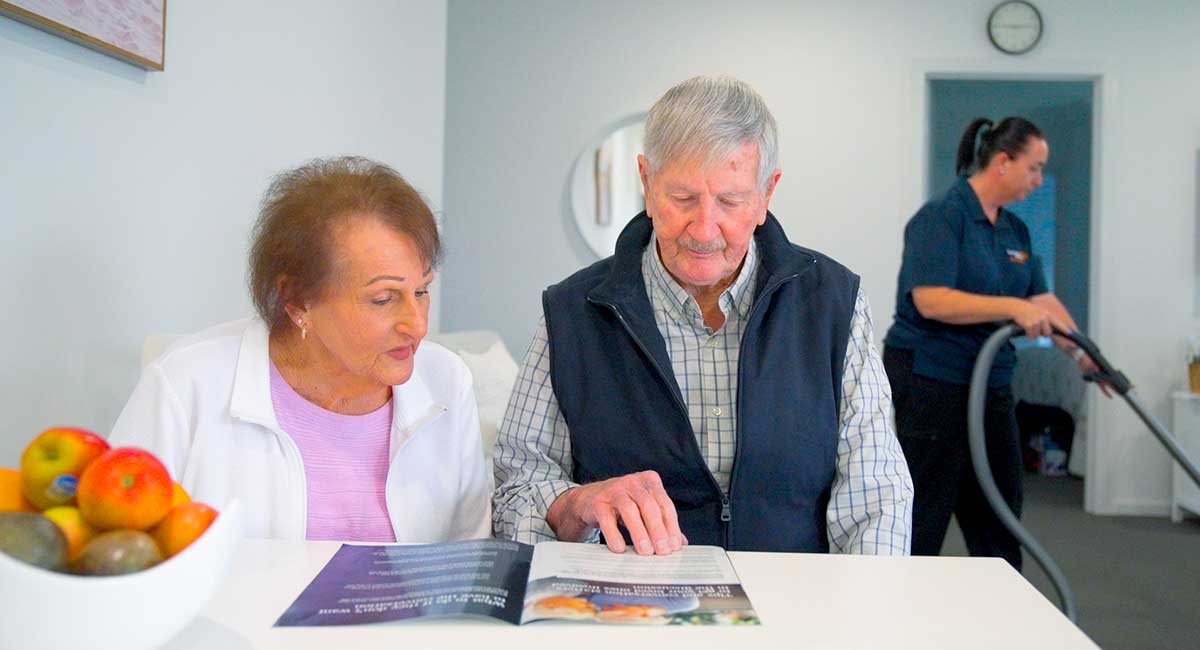
Tina has been George and Lynn’s home care support worker, visiting for domestic assistance. She describes it as "vacuuming, dusting, mopping, cleaning the kitchen, cleaning the bathroom and ending it off with a chat.”
Tina’s been with Australian Unity for eight years, since her own children were young. “The role’s flexible for me, with school-age kids,” she says. “It helps me get them off to school, enjoy my work for the day, then pick them up again, so we’re all happy.”
What keeps her coming back is simple: “I know that I’m helping clients live longer and easier in their own home. That’s what I love the most.”
As Lynn and George’s needs have changed, so has their support. “The services have moved along with us,” Lynn says. “They’ve been really great and they’re there to continue to help us.” New equipment has come as needed too—new chairs and a walker for George, “just in case he needs it”.
For Lynn, it’s the small things that mean the most. “It’s lovely to see them, because it’s like family coming.”
Staying in the game
Ask George what he does with his days now and baking still comes up—just on a smaller scale. “All I do now is I make Scotch shortbread, for the pensioners or others, Christmas and Christmas in July,” he says. “That’s all the day now.”Sport hasn't slowed down much either. Both look back on a shared sporting life with pride. “I’ve always done sport all my life,” Lynn says. “I’ve been in the athletics and everything and then physical culture. I'm still involved in that.”
Michelle sees the same spark in her parents that’s always been there. “They absolutely adore their grandchildren,” she says. “When I bring them round, their faces just light up. That’s their highlight—it’s amazing how much they light up, because family is their world.”
Their advice … make the most of what’s on offer
Lynn and George have recommended Australian Unity to friends facing the same decisions they once did. “Some have taken it up, because we’ve told them how good Australian Unity is, and they’re keen to get in,” Lynn says.Her advice to anyone hesitant about accepting support is straightforward: “Accept what has been given to you and get used to it—because you don’t, at the start. You think, I can still do this. But you can’t. You need help.”
Michelle’s advice, from the family’s side, is not to wait. “Get more buy-in from whoever’s not so keen to start with,” she says. “Try before you buy—jump in and start looking at all this stuff. Because you never know when the next day is going to change. You really don’t.”
Sixty-one years on, Lynn and George are still finding their rhythm—together with some support. As George would say, they’re not worn out yet!