“Financial wellbeing is about feeling safe and confident about the future. It’s being able to traverse any crises that might arise without panic. And it’s the freedom to make choices about your future and your family.”—Adnan Glinac, EGM of Life & Super at Australian Unity
Key points
- Standard of living, or finances, is a critical factor in achieving and maintaining Real Wellbeing.
- Findings from the Australian Unity Wellbeing Index show wellbeing continues to improve with household income, telling a different story from previous years.
- People on lower household incomes can achieve financial security, but they need to be strategic and disciplined with how they use their money.
Conversations about wellbeing often focus on physical or mental health.
But our finances, or standard of living, are a very important factor too—and one of the three pillars of the “golden triangle of happiness”, along with personal relationships and achieving in life.
Adnan Glinac, EGM of Life & Super at Australian Unity, is a firm believer in the benefit that financial wellbeing has on a person’s life.
“Financial wellbeing is all about feeling safe and confident about the future, and being able to traverse those occasional crisis situations that can come up without panic. When you feel financially secure, you’re able to meet the ups and downs of life with far greater confidence,” says Adnan.
He says that while overall wellbeing isn’t all about finances, there’s no denying how many areas of your life and day-to-day existence can be impacted by financial security or insecurity.
“Money and income provides stability and choice. It gives you housing, health care, transport, the essentials that allow you to navigate life comfortably. Without enough money for those things, it causes stress and angst or worse.”
So, does that mean money can also buy happiness?
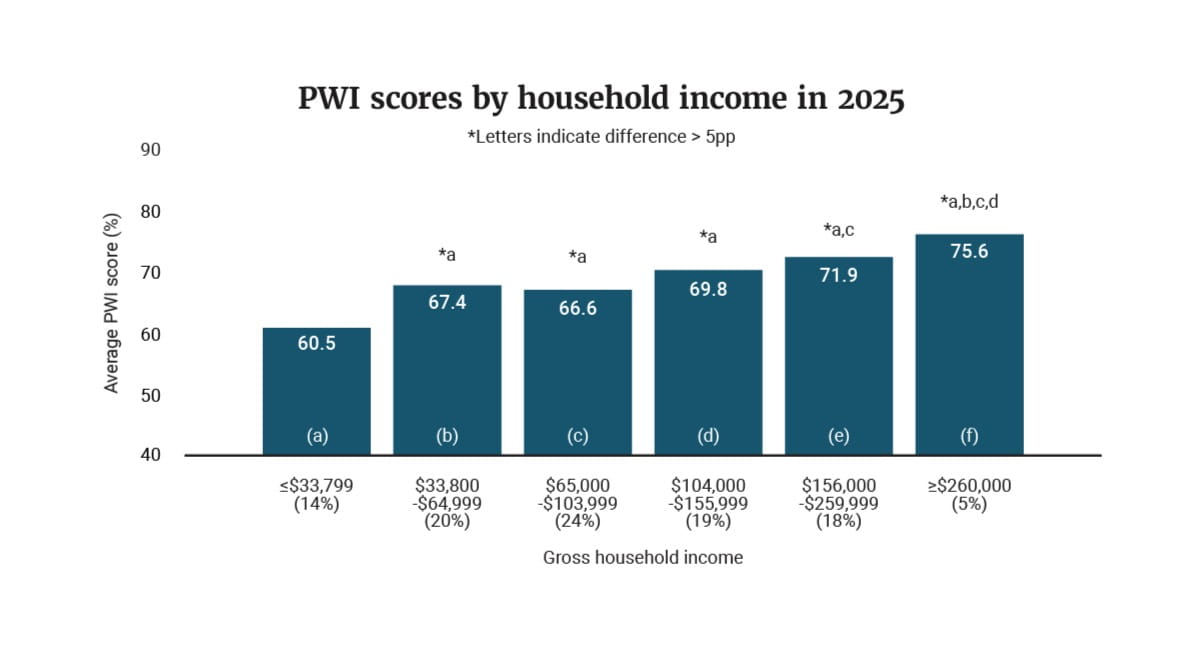
Higher wellbeing for those with higher household income
In previous years, the Australian Unity Wellbeing Index (AUWI) had found that personal wellbeing improved in line with household income but only up until a certain amount.
For example, in 2021, the results found that household income only improved wellbeing up until it reached the $101,000 to $150,000 range—at which point the relationship between money and wellbeing weakened. This fits well with the old adage ‘money can’t buy happiness’.
In recent years however, the results have told a different story. Lately, the wellbeing of Australians has continued to improve exponentially in line with household income, with people on the highest household income reporting the highest wellbeing.
So, what might be causing this change? Adnan suggests that cost of living is at play.
“People with more in their hands are able to withstand the pressures that are coming from day-to-day costs increasing and appreciating at an unprecedented level,” he says. “They have more of a buffer to deal with the current environment.”
And for people on lower household incomes…
The reverse also holds true, with the research showing that people living on a gross household income of $104,000 or less struggle to reach an average level of wellbeing. Our research shows that even a moderate level of financial strain can cause wellbeing to unravel.
“If you worry about not being able to pay rent or your mortgage or buy basic necessities, that can be detrimental to your wellbeing,” says Adnan.
The stress of an unexpected bill, a health issue, a rent increase or a job loss can be huge.
Australian Unity Wellbeing Index lead researcher Kate Lycett agrees that the knock-on effects of financial insecurity, especially during the cost of living crisis, are wide reaching.
“Some people are working two jobs just to pay their rent or they're working hard to pay off big mortgages. Young people might be studying and working really long hours. So the time to invest in personal relationships, community connectedness or other wellbeing domains just isn't there,” she says.

Finding financial (and overall) wellbeing
With that said, can those on a low household income still be happy?
Adnan stresses that there are multiple factors that play into your wellbeing and overall happiness.
“Wellbeing comes from relationships, your purpose in life, the things that you stand for, your health and the community that you surround yourself with. Extreme wealth doesn’t necessarily materially add to your wellbeing.”
In fact, despite ongoing cost of living challenges, Australians reported a small increase in personal wellbeing in the latest AUWI.
But having less money does put greater importance on how you use that money, says Adnan.
“You need to have even more discipline around when you save, how much you save and when you invest, so you make your money work harder for you.”
“Make sure you are steely about your budget. Review the basics like insurance and power bills so you’re not overspending unnecessarily. Then when there is some extra money, be strategic in how you use it.”
Remember that the “golden triangle of happiness” has three components. Even if your finances or standard of living are ample, if you don’t prioritise other areas like personal relationships and a sense of achieving in life, you may find it hard to have a well-rounded life and feel truly happy.
.jpg)

.jpeg)